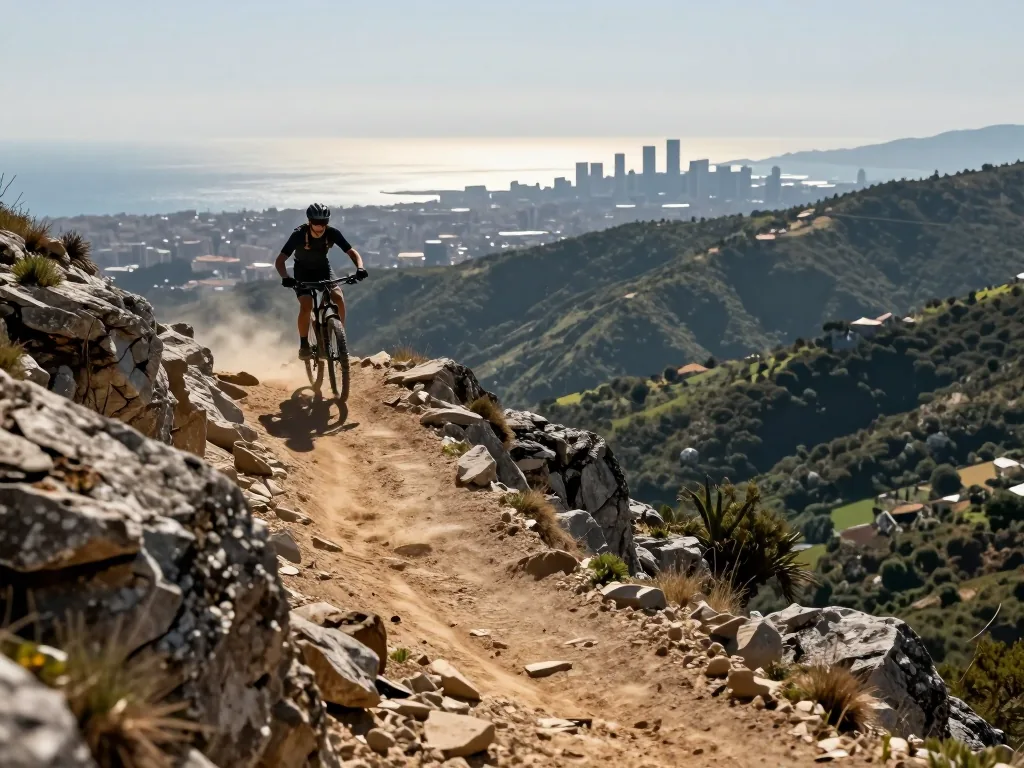
The Ultimate 2026 Guide to an Epic Single Day Mountain Bike Trip from Barcelona
Conquer epic trails on a single day mountain biking trip from Barcelona. Your ultimate 2026 guide to routes, rentals, and logistics for an unforgettable ride.
Barcelona’s sun-drenched coastline and vibrant city life are legendary, but just beyond the urban sprawl lies a world-class network of trails waiting to be shredded in a single day. In 2026, a quick train or drive can transport you from tapas bars to technical singletrack. It’s an epic escape without the need for overnight gear. This guide cuts through the noise to deliver the ultimate one-day mountain bike itinerary, packed with trail recommendations, logistics, and insider tips for maximizing your ride. Whether you’re chasing flowy descents in Collserola or rugged climbs in Montserrat, you’ll finish this article ready to pedal from pavement to paradise and back before dinner.
Understanding the Collserola Natural Park in 2026
Just 20 minutes by bike from Plaça de Catalunya, Collserola Natural Park is not merely a convenient escape—it is the definitive single-day mountain biking destination for anyone based in Barcelona in 2026. This sprawling 8,000-hectare green lung, crowned by the iconic Tibidabo mountain, offers over 300 kilometers of trails. They range from smooth forest roads perfect for a relaxed spin to technical singletrack that will test your nerve. What sets Collserola apart in 2026 is its maturity as a managed trail system. It is no longer a patchwork of unofficial paths but a cohesive, well-signed network designed to accommodate everyone from gravel riders to enduro enthusiasts.
Why Collserola is the Top Choice for a Day Trip
For the rider with limited time, Collserola’s geometry is unbeatable. You can pedal from the city edge to the heart of the park in under 30 minutes. That means you can stack four to six hours of quality riding into a single morning or afternoon and still be back for a late lunch. The park’s elevation profile—peaking at 512 meters at Tibidabo—offers sustained climbs and punchy descents without requiring a full-day alpine effort. Crucially, the Mediterranean climate in 2026 means the trails are rideable year-round, though summer heat pushes early starts. The park also provides critical infrastructure: water fountains at major junctions, bike repair stations at the Collserola Information Center, and multiple access points via the Ferrocarrils de la Generalitat (FGC) trains, which now allow bikes without a reservation on off-peak services.
Trail Network and Official Signage System
Navigating Collserola in 2026 is straightforward thanks to a comprehensive signage overhaul completed in late 2025. The network is color-coded by difficulty: green for easy, blue for moderate, red for difficult, and black for expert. Each trail is marked by a numbered post every 500 meters. Key routes include the “Ruta de les Aigües” (blue, 12 km, mostly flat gravel) for warm-ups, and the “Carena de Collserola” (red, 8 km, with 350 meters of descending) for technical thrills. The official map—available as a free PDF or for €3 to €5 at the Information Center—shows mandatory one-way sections and seasonal closures.
The Consorci del Parc Natural de la Serra de Collserola maintains all trails and provides a dedicated mountain biking map at the Collserola Information Center. In 2026, the park enforces strict trail closures after heavy rain to prevent erosion; always check their official website or social media before departure.
This system means you can confidently link loops without a GPS device, though a mobile app like Trailforks is recommended for real-time updates on trail conditions. For a single epic day, aim for a 35–50 km loop that connects the southern slopes (accessible from the Vallvidrera FGC station) with the northern ridges toward Sant Cugat. This route delivers varied terrain, sweeping views of the Mediterranean, and a satisfying mix of ascending and descending.
Getting to the Trailhead from Central Barcelona
Your epic single-day ride starts beneath the grand stone arches of Plaça de Catalunya—not at a dusty trailhead. The most efficient and scenic escape from asphalt to the singletrack of Collserola Natural Park is the Ferrocarrils de la Generalitat de Catalunya (FGC). This isn’t just a commute; it’s the first leg of your adventure, offering a smooth transition from urban bustle to forest silence.
Using the FGC Train to Baixador de Vallvidrera
Forget driving Barcelona’s notorious ring roads or hunting for scarce parking. The train is your best friend. Head to the FGC station at Plaça de Catalunya, accessible from any metro line. Board the S1 or S2 line—specifically trains marked for Terrassa or Sabadell. They depart every 10–15 minutes during peak hours, with slightly longer gaps on weekends. The ride is a visual appetizer: as the train climbs, apartment blocks give way to terraced hillsides and Mediterranean pines. After roughly 30 minutes, alight at Baixador de Vallvidrera station. A single ticket from Plaça de Catalunya costs from €4 to €6 per person (one-way). A T-10 card (10 trips) or T-Jove youth card can bring the per-ride cost down to around €2 to €3 per trip if you plan more public transit later.
Navigating from the Station to the Start of the Loop
Step off the train, and the air is cooler and cleaner. The station is small, but navigation is straightforward. Exit the platform onto a quiet residential street. Your next move is a short, punchy climb: follow the paved road uphill for exactly 500 meters. This tarmac section serves as a gentle warm-up and a chance to dial in your suspension. At the top, you’ll intersect the Carretera de les Aigües—a wide, unpaved fire road that is the network’s main artery. This is your official trailhead. From here, dozens of interconnected loops are immediately accessible. For a classic, all-day epic, turn left (northwest) onto the Carretera de les Aigües and ride about 1.5 kilometers until you see the marked entrance for the Tibidabo or Collserola single-track systems. This paved road approach is the only logical way to start your loop, ensuring you hit the dirt with fresh legs and a clear route ahead.
Essential Gear and Bike Setup for the Terrain
A single-day mountain bike trip from Barcelona demands a bike that handles everything from loose, rocky descents to punchy, root-strewn climbs. The Collserola trails aren’t alpine-level technical, but they’re relentless in their variety. For 2026, the sweet spot is a modern trail hardtail or lightweight full-suspension bike with 120–140mm of travel. Tires should be at least 2.2 inches wide—ideally 2.3 to 2.4—with a semi-aggressive tread pattern like a Maxxis Dissector or Schwalbe Nobby Nic. These provide grip on dry, dusty corners and exposed bedrock slabs without turning climbs into a drag race. Disc brakes are non-negotiable; a 180mm rotor front and 160mm rear is the minimum for controlling speed on steep, switchback-laden descents near the Tibidabo ridge.
Recommended Bike Specifications for 2026
For a self-supported day loop, avoid ultra-light XC race bikes that sacrifice durability. Instead, aim for a bike with a dropper post (150mm travel minimum), a 1x drivetrain with a 32-tooth chainring paired with a 10-50 or 10-52 cassette, and tubeless-ready wheels. In 2026, the standard for rim width is 30mm internal, which lets you run lower tire pressure (around 22–24 psi front, 25–27 psi rear) for traction without pinch flats. If renting in Barcelona, expect to pay €45 to €90 per day for a bike meeting these specs. Avoid anything with less than a 2.1-inch tire or rim brakes—the terrain will punish you.
What to Pack for a Self-Supported Ride
You’ll be completely on your own for the 6–8 hour loop, so pack smart. Start with the essentials: a mountain bike with front suspension (hardtail or full-suspension) and tires at least 2.2 inches wide. Helmet, gloves, and eye protection are mandatory—the sun is intense, and low-hanging branches on singletrack are common. Carry a spare tube, tire levers, a mini pump, and a multi-tool with chain breaker and spoke wrenches. At least 2 liters of water per rider is non-negotiable; refill at the Collserola Information Center (open until 14:30 on weekdays) or the Font de la Budellera fountain near the Vallvidrera reservoir. Pack high-energy snacks like trail mix, energy bars, and a light lunch—there are no food services on the loop. Finally, a fully charged phone with an offline map app (like Trailforks or Komoot) is your lifeline; cell reception is spotty in the deeper ravines.
The Classic Loop: Carretera de les Aigües to Pista de la Rabassada
This is the quintessential Barcelona day trip—a loop that combines the city’s most famous panoramic fire road with a thrilling descent into technical singletrack. It rewards fitness and bike handling in equal measure. In 2026, it remains the go-to choice for riders who want a full-day challenge without leaving the Collserola Natural Park.
Route Overview and Key Waypoints
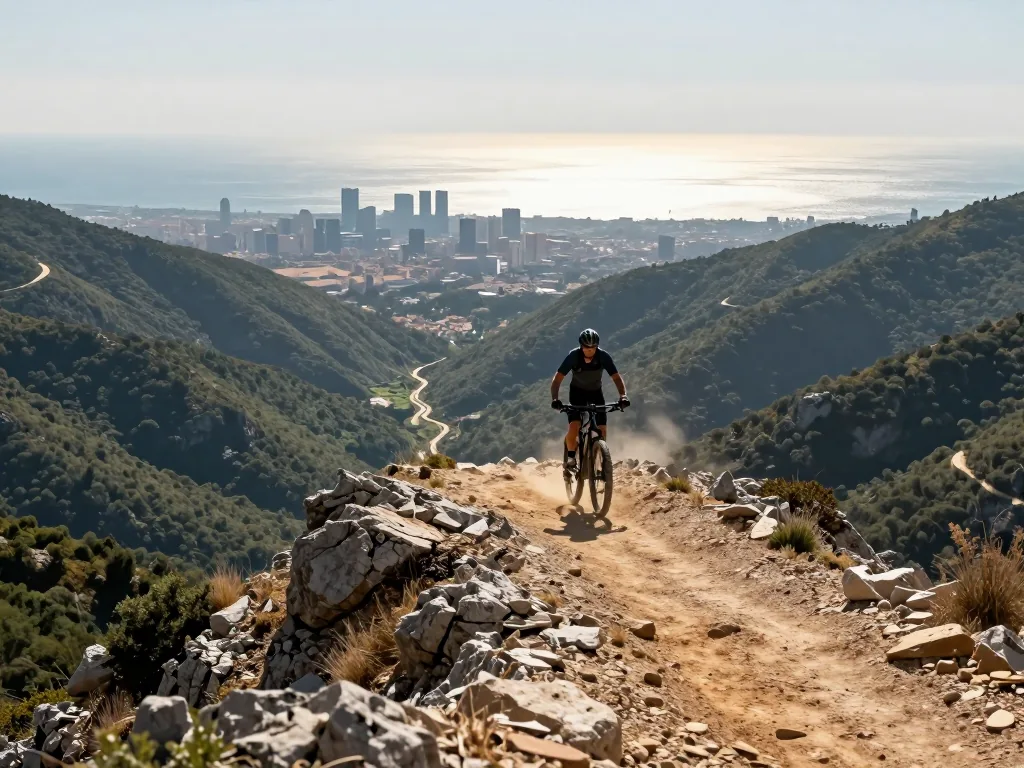
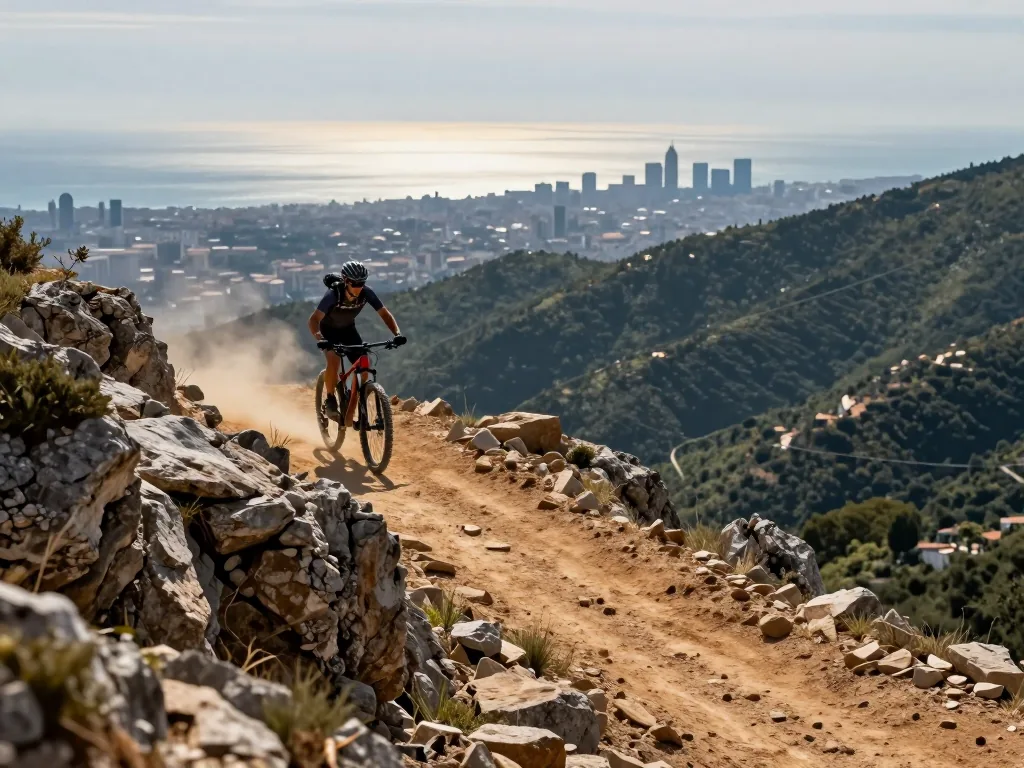
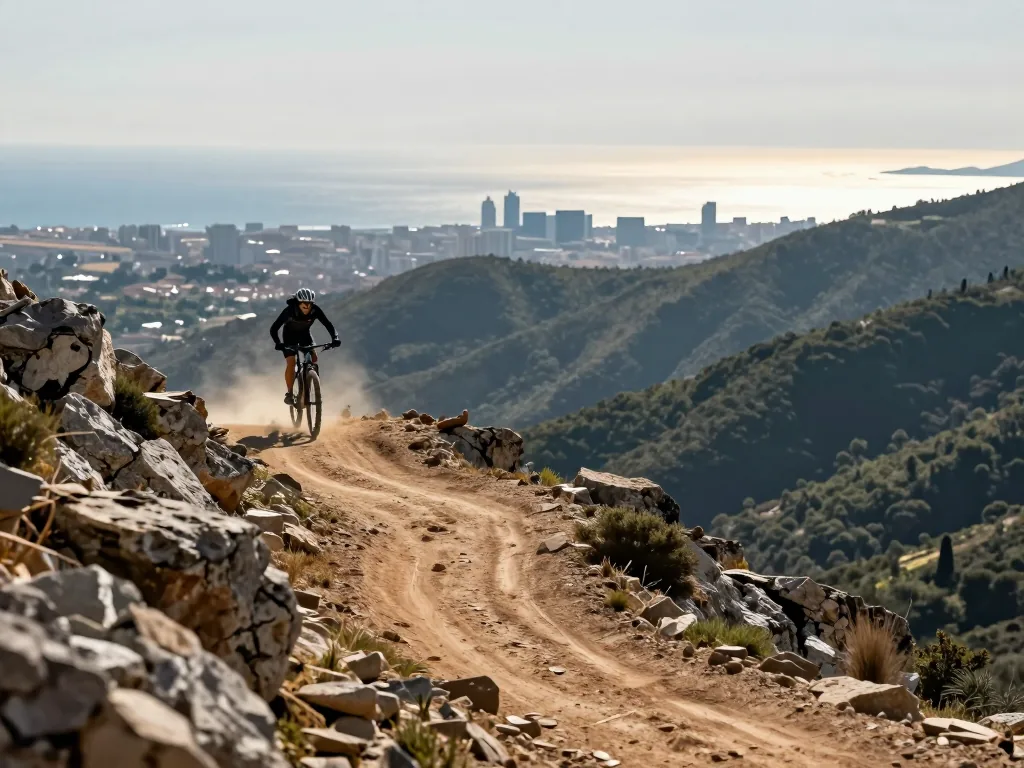
Start your ride from the Tibidabo foothills. The loop covers 25–35 kilometers with 600–800 meters of elevation gain, depending on your exact start point and whether you add the optional “Sprint to the Top” variant. The first major waypoint is the Carretera de les Aigües, a wide, undulating fire road that hugs the ridge above Barcelona. This is your warm-up: smooth, scenic, and often crowded with runners and walkers on weekends. Follow it east for about 8 kilometers, keeping the Mediterranean glittering to your right. At the Mirador de la Rabassada—a small stone viewpoint—turn left onto the Pista de la Rabassada. This narrower, rougher track signals the end of the easy miles. From here, the route drops into a network of tighter singletrack, often marked with faded red-and-white paint. Key waypoints to watch for: the Coll de la Rabassada (a rocky saddle at about 450 meters elevation) and the Font de la Budellera (a natural spring where you can refill bottles). The final 5 kilometers are a steep, loose descent back toward the car park or train station at Peu del Funicular.
Technical Sections and Pacing Advice
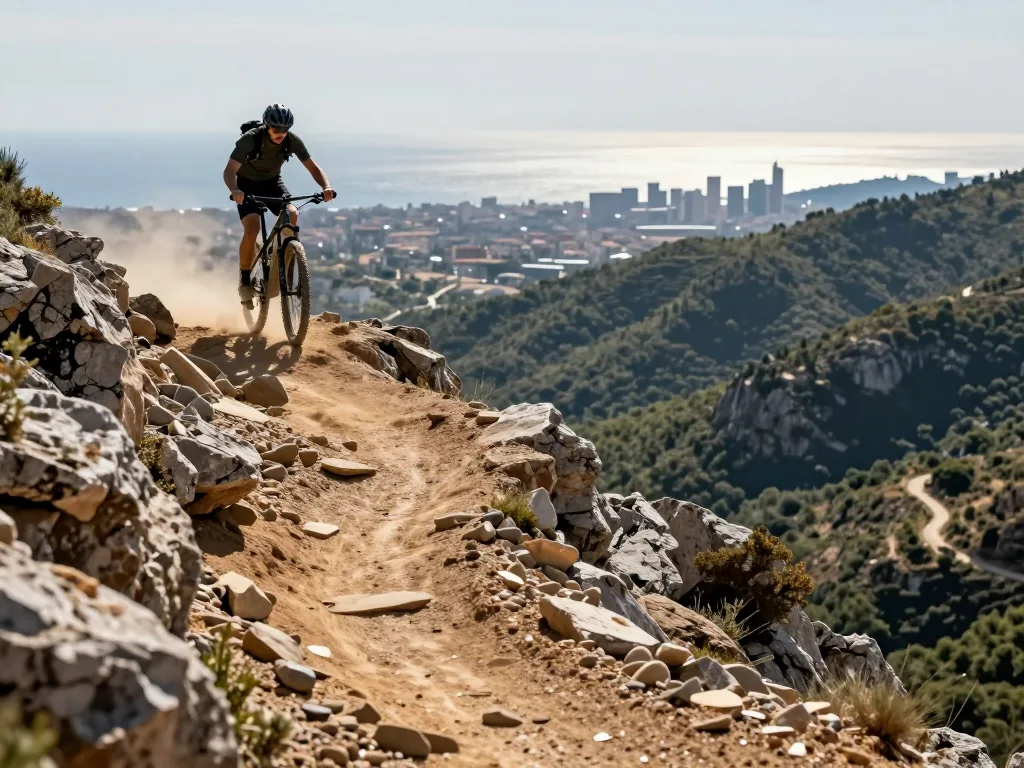
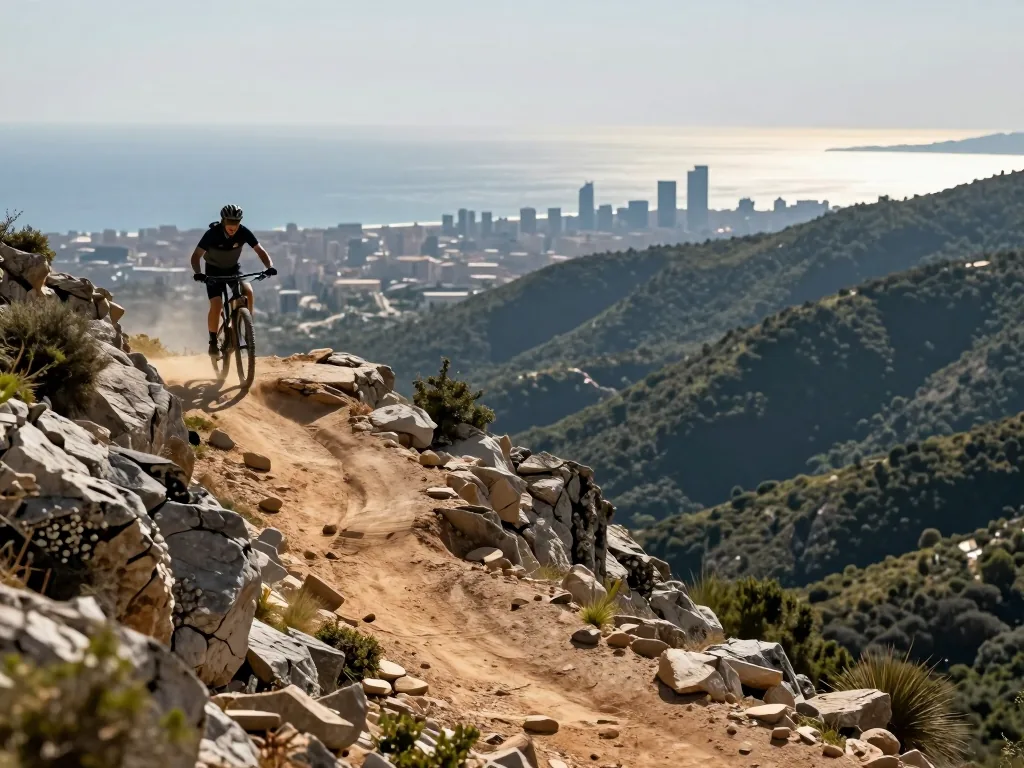
The Carretera de les Aigües is deceptive: it looks flat but gains elevation steadily, so pace yourself. Keep your cadence high and your heart rate in Zone 2. The real challenge begins on the Pista de la Rabassada. Expect rocky singletrack, loose gravel, and short technical climbs that demand quick weight shifts and precise line choice. The first 2 kilometers feature several steep switchbacks where momentum is your friend—don’t brake too early. Once past the Coll de la Rabassada, the trail opens into a fast, flowy descent with embedded rocks. Stand on the pedals, keep your eyes scanning 10 meters ahead, and let the bike drift over loose sections. On a hardtail, drop your saddle 2–3 centimeters before the descent to improve control. Plan for 4–6 hours total, including stops for photos and rest. A good rule: spend no more than 20 minutes at any viewpoint—the light changes fast in the afternoon, and the descent is best ridden before shadows make the rocks harder to read.
The loop covers 25–35 kilometers with 600–800 meters of elevation gain. Expect rocky singletrack, loose gravel, and short technical climbs. Plan for 4–6 hours total, including stops for photos and rest. The Carretera de les Aigües is a wide, scenic fire road ideal for warming up, while the Pista de la Rabassada features tighter, more technical singletrack.
Navigation and Trail Etiquette
Navigating the trails around Barcelona in 2026 is far easier than it was just a few years ago, thanks to a major overhaul of the regional signage system. However, knowing how to read the signs and behave on the trail is the difference between a smooth ride and a frustrating—or even dangerous—day out.
Using Official Signage and Maps
The key to staying on track is following the green and white mountain bike markers installed by park authorities. These aren’t generic arrows; they are part of a color-coded network indicating difficulty and direction. A green circle marker typically means a beginner-friendly gravel path or fire road, while a blue square signals a moderate singletrack with some technical features. A black diamond, as you might expect, is for expert-level terrain with steep drops, rock gardens, and tight switchbacks. Before leaving your accommodation, download the official park map from the Consorci website, the regional park management body. This digital map, updated for 2026, includes real-time trail closures, water fountain locations, and emergency contact points. Do not rely solely on third-party apps like Strava or Trailforks for navigation. While excellent for tracking your ride, they often miss recent trail reroutes or seasonal closures that the official map highlights. Carry a fully charged phone in a waterproof case, but also bring a small power bank—battery drain is common when using GPS all day.
Sharing the Trail with Hikers and Other Users
The trails around Barcelona are shared spaces. You will encounter hikers, trail runners, families with strollers, and on certain fire roads, horses. The universal rule is simple: yield to hikers and horses. When approaching a hiker from behind, slow to a walking pace and announce your presence clearly—a friendly “Buenas, pasando por la izquierda” (Good day, passing on your left) works well. Never assume they hear you coming, especially on windy singletrack. For horses, stop completely and dismount if necessary; a sudden bike can spook a horse and cause serious injury. Additionally, do not ride on closed or wet trails. In 2026, park rangers are actively issuing fines for trail damage, particularly in Collserola Natural Park and the Montseny area. Riding on saturated mud creates deep ruts that erode the trail for months. If dirt is sticking to your tires in clumps, it is too wet. Turn around and find an alternative route. Finally, always yield to uphill riders—they are working harder and have less control on a steep climb. A polite nod or quick “gracias” goes a long way toward keeping the community respectful.
Food, Water, and Logistics on the Trail
Proper hydration and nutrition are the backbone of a successful single-day mountain bike trip from Barcelona, and the Collserola loop demands careful planning. Unlike a road ride with cafés every few kilometers, this trail is a self-supported adventure through rugged Mediterranean forest. The good news is that two reliable water refill points exist along the route, but you must know where they are. Your first stop is the Collserola Information Center, located near the trailhead at the foot of the main climb. Fill your bottles here to capacity before you start the ascent. The second, and only other guaranteed source, is the Font de la Budellera fountain, a natural spring-fed tap roughly mid-loop, just after the technical descent from Turó de la Magarola. This fountain flows year-round, but in dry summer months, it can slow to a trickle, so always carry a backup filter or purification tablets. Beyond these two points, there are no food services—no cafés, no kiosks, no vending machines—anywhere on the main loop. You are in a genuine no-food zone for the entire 30–40 kilometer ride. Pack everything you will eat: solid energy bars, gels, nuts, and a substantial sandwich or wrap for a mid-ride break. A typical day’s calorie burn on this terrain exceeds 2,500 kcal, so bring at least 1,000 kcal of portable food, plus two full liters of water (three in summer).
Timing your return to the train station is equally critical. The last train from Baixador de Vallvidrera to central Barcelona (Plaça de Catalunya) departs around 11:00 PM during the summer 2026 timetable, but do not cut that margin too close. Mechanical issues—a snapped chain, a punctured tire, or a seized derailleur—can easily add 30 to 90 minutes to your day, and fatigue in the final hours slows your pace dramatically. Aim to finish the loop by 8:00 PM at the latest. This gives you a generous three-hour buffer to limp back to the station, fix a flat, or simply rest if you’ve underestimated the climb’s difficulty. If you miss the last train, a taxi from Baixador de Vallvidrera to central Barcelona will cost from €25 to €40 per ride, depending on traffic and demand. Plan your start time accordingly: if you begin pedaling by 9:00 AM, you’ll have ample daylight and a comfortable cushion for a stress-free return.
Weather, Trail Closures, and Seasonal Considerations
Planning a single day mountain bike trip from Barcelona in 2026 demands more than just picking a trail on a map. The Mediterranean climate and local conservation rules mean conditions can shift quickly. Knowing what to expect before you pedal is the difference between an epic day and a frustrating one.
Checking Real-Time Trail Status in 2026
Gone are the days of guessing whether a trail is open. In 2026, the Parc de Collserola — Barcelona’s primary mountain biking backyard — updates its official website and social media channels daily with real-time trail status. Check these sources before you load your bike. Heavy rain, even a single overnight downpour, can trigger immediate closures. The park’s conservation team shuts down sensitive singletrack sections to prevent erosion and protect flora. If you see a red flag on the digital map, respect it. Riding closed trails risks fines, trail damage, or worse — you might get turned around miles from the car. A quick glance at the park’s Instagram story or the “Trail Status” tab on their site takes thirty seconds and saves hours of hassle.
Riding in Summer vs. Winter Conditions
Summer in Barcelona is relentless. By late morning, the sun bakes the Collserola hillsides, and temperatures on exposed ridgelines can climb past 35°C (95°F). If you’re riding between June and September, start by 7:00 AM. This gives you three to four hours of cool, shaded riding before the heat becomes dangerous. Pack at least two litres of water, and plan your route to include a mid-morning café stop in a village like Sant Cugat or Horta. Winter flips the script. Days are short — sunset can hit as early as 5:30 PM — and temperatures drop to 5-10°C (41-50°F) in the hills, with wind chill making it feel colder. Layering is non-negotiable: a breathable base layer, a windproof jacket, and packable gloves. Plan your return to the trailhead by 4:00 PM at the latest to avoid riding the final descent in darkness. The trails themselves are often drier and faster in winter, with fewer leaves obscuring roots and rocks, making it a prime season for flowy, technical laps.
Collserola trails are open year-round but may close after heavy rain for conservation. In 2026, the park updates trail status daily on its official website and social media. Summer rides require early starts (by 7:00 AM) to avoid midday heat; winter rides demand warmer layers and earlier return due to shorter daylight.
Advanced Tips for an Epic Experience
To elevate your single-day mountain bike trip from Barcelona beyond the standard loops, layer in strategic extensions and a solid safety mindset. The difference between a good ride and an unforgettable one often comes down to the optional singletracks you choose and how prepared you are for the unexpected.
Extending the Loop with Optional Singletrack
Once you’ve conquered the classic Collserola backbone—say, the climb from Sant Cugat to the Turó de l’Home viewpoint—consider weaving in two of the area’s most rewarding technical additions. The Cami de la Budellera is a steep, rocky descent that drops sharply toward the Vallvidrera reservoir. It’s not for beginners: expect loose stones, tight switchbacks, and sections where you’ll need to dab or dismount. In return, you get a thrilling, rooty plunge that cuts minutes off your descent while testing your bike-handling limits. Alternatively, the Torrent de la Font singletrack offers a more flowy but equally challenging traverse along a narrow, shaded stream bed. It adds roughly 4 to 6 extra kilometers to your loop, pushing your total distance into the 50–60 km range, and forces you to navigate technical climbs and creek crossings. Both tracks are best ridden after a dry spell—wet rocks turn them into slick, dangerous slip ’n slides. Tack them on as a mid-ride reward after the main climb, but only if your legs and lungs still have a reserve.
Emergency Preparedness and Local Contacts
Even on a well-marked trail network, remote sections of Collserola can feel isolated—especially if you deviate from the main gravel paths. Before you roll, save two critical contacts in your phone: the Collserola Park ranger station (93 280 35 52) and the universal European emergency number 112, which covers ambulance and rescue services. Cell reception is patchy in the deeper valleys, so download offline maps (OsmAnd or Gaia GPS work well) and carry a small first-aid kit with bandages, antiseptic wipes, blister pads, and a compression bandage. Know the nearest exit points to the FGC train line (stations like Baixador de Vallvidrera, Les Planes, or Sant Cugat) so you can bail quickly if a mechanical or injury sidelines you. Finally, ride with at least one partner on these extended loops. A solo crash on a remote singletrack like the Budellera could mean waiting hours for help, and a partner can stabilize a fracture or ride out for assistance. In 2026, the cost of a decent first-aid kit runs from €15 to €35, and a backup power bank for your phone from €20 to €50—small investments that turn a potential disaster into a manageable hiccup.
Conclusion
A single day mountain bike escape from Barcelona offers more than just a ride—it’s a full sensory reset. World-class trails, Mediterranean views, and a taste of Catalonia’s wild heart are all within an hour’s drive. Whether you choose the technical granite of Montserrat, the flowy singletrack of Collserola, or the volcanic terrain of La Garrotxa, the key takeaway is clear: you don’t need a multi-day trip to experience epic singletrack from the city. Your next step is simple. Pick your trail. Check the 2026 trail conditions online. Book a rental bike or shuttle. Set your alarm for an early start. Go ride, refuel with a proper paella afterward, and return to Barcelona in time for sunset. That’s the ultimate single-day formula.
Gallery
Frequently Asked Questions
What are the best mountain biking destinations for a single day trip from Barcelona in 2026?
The most popular and accessible options include the Collserola Natural Park, just outside the city, the Montserrat mountain range, and the trails around La Mola or Sant Llorenç del Munt. Each offers a mix of singletrack and fire roads, with distances suitable for a day trip.
How do I get my bike from Barcelona to the trailheads?
You can take your bike on Rodalies (local Renfe) trains, which allow bicycles outside peak hours, or use the metro with a folding bike. Many riders also drive or use a bike-friendly ride-sharing service, as parking is available at most trailheads.
What is the typical difficulty level of trails near Barcelona?
Trails range from easy green routes in Collserola to challenging black diamond descents in Montserrat. Most single-day trips offer intermediate (blue) terrain with technical sections, but you can find options for all skill levels if you research specific routes beforehand.
What should I pack for a single day mountain biking trip from Barcelona in 2026?
Bring at least 2 liters of water, a repair kit with a spare tube, sunscreen, and a charged phone with offline maps, as cell reception can be spotty. Also pack a lightweight jacket, as mountain weather can change rapidly even in summer.
Are there guided mountain biking tours available from Barcelona?
Yes, several local outfitters offer guided day trips to popular areas like Montserrat or the Garraf Natural Park, providing transport and trail support. Booking in advance is recommended, especially during peak season from April to October.
What is the best time of year for a single day mountain biking trip from Barcelona in 2026?
Spring (March to May) and autumn (September to November) offer the best conditions with mild temperatures and dry trails. Summer can be extremely hot, so start early in the morning, and winter trails may be muddy after rain.
Do I need a special permit to ride in natural parks near Barcelona?
Most trails in Collserola and Garraf are open to mountain bikers without a permit, but some sections of Montserrat require a free online registration for access. Check the park's official website the day before your trip for any fire-risk closures or updates.
Can I rent a mountain bike in Barcelona for a day trip?
Yes, many bike shops in the city offer high-quality mountain bike rentals for single-day use, often including a helmet and lock. Reserve your bike at least 24 hours in advance, especially on weekends, to ensure availability.
How long does it take to reach the trailheads from central Barcelona?
By train, Collserola is about 30 minutes from Plaça de Catalunya, while Montserrat takes roughly 1 hour. Driving to Sant Llorenç del Munt takes around 45 minutes, depending on traffic. Plan for an additional 15-20 minutes to assemble your gear at the start.